The father-son relationship between Isaac and Henry English
American RustIsaac English and Henry English are father and son whose bond is transformed by Henry’s accident and the practical demands of his disability. Isaac remembers a father who lifted him from the crowd at the steel mill; as a young man, he lives with and cares for a father he now thinks of as an old man. Their relationship is held together by years of daily responsibility, but also strained by control that is rarely stated directly, grievances Isaac cannot settle, and his fear that leaving would make him a bad son.
Before and After the Accident
Isaac’s childhood memory of Henry belongs to the working life that preceded the family’s changed circumstances. At shift change, men streamed from the billet mill coated in steel dust, and Isaac remembers Henry as tall and shimmering in the sunlight, reaching down to lift him. The recollection makes the contrast with their later household especially stark: after an accident, Henry is a wheelchair user with a spinal injury at L1 and progressive neuropathy. The text does not specify the accident’s circumstances here, but makes clear that it altered both Henry’s physical life and Isaac’s role in the family.
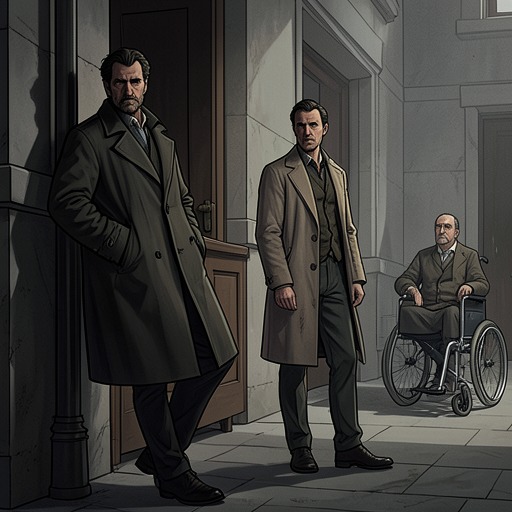
The family’s house carries the same contrast between former standing and present decline. It is a Georgian Revival house originally built for a steel-mill manager, and Henry had worked overtime to buy it and was proud of it. Years later, Isaac sees his father sitting in a wheelchair on the back porch, looking across the hills from a property and home that no longer seem to embody their former security. The scene sharpens Isaac’s sense of obligation: he is not only leaving a parent who needs care, but also turning away from the household his father worked to establish.
Care, Dependence, and Unspoken Control
For five years after Mary English’s death, Isaac lives alone with Henry. The arrangement makes Isaac’s caregiving both intimate and isolating: he has remained in the house while his sister, Lee, has been away, and he resents what he sees as the imbalance between his years of care and her brief visits. He imagines that Henry and Lee will arrange a nurse once he is gone, while also accusing himself of abandoning his father. His thoughts shift between anger at being left with the burden and doubt that he has any right to complain.
Henry’s influence over Isaac often works through implication rather than an open demand. Isaac remembers accepting a job at the Carnegie Library that required two hours each way by bus. When Henry became ill and made four visits to the doctor in a week, Isaac gave in and stayed. Isaac reads the episode as his father’s indirect way of keeping him home: Henry did not say what he wanted, but Isaac understood the pressure and also admits that part of him was glad to yield. That mixture of compliance and attachment helps explain why the relationship cannot be reduced to either devotion or resentment.
The same pattern appears in a dispute over a car. Henry tells Isaac not to borrow it again without saying where he is going and when he will return. Isaac recognizes that the car represents his only freedom, and resents that his father could have lent him money to buy one but did not. Yet his anger is accompanied by self-criticism: he knows how long he has stayed, and sees his own willingness to give in as part of the reason he remains trapped. Henry’s authority is real, but Isaac’s account also shows how much of its force depends on the son’s own divided feelings.
Leaving and the Burden of Guilt
At twenty, Isaac takes money from Henry’s desk and plans to leave Buell for California, travelling by rail through Pittsburgh. He corrects himself from thinking that he has merely taken the money to recognizing that he has stolen it. The distinction reflects the moral weight he gives his departure: escape is not a clean break but an act bound up with betrayal, dependence, and the belief that he has already failed his family. He has been planning the journey for a month, yet his thoughts repeatedly return to whether Henry will be all right and whether leaving makes him the villain in the family story.
When Isaac comes home after the killing at the machine shop, Henry does not mention the stolen money. The two look at one another and nod. The silence is consequential, but it does not settle what either man knows or feels; the scene offers no reconciliation or explicit forgiveness. In the morning, Isaac watches Henry from his upstairs window, then later sees him seated in his wheelchair on the back porch as he prepares to meet Billy Poe. That view makes the decision to leave concrete: Isaac is departing from a father who remains physically present, not from an abstract past.
The Relationship’s Unresolved Terms
Isaac’s private judgments of Henry are severe. He describes his father as interested chiefly in himself, then checks that judgment against Henry’s spinal injury and the dependence it brings. In his own thoughts, Isaac invokes the example of Stephen Hawking and the demands of long-term care, questioning whether he would have behaved better in his father’s position. The comparison does not erase his grievances; it shows him testing them against the realities of disability and dependence, without arriving at an easy verdict.
The father-son relationship therefore makes Isaac’s departure a conflict between care and self-determination rather than a simple rejection. Henry once lifted Isaac from the steel-mill crowd; later, Isaac stays home to help sustain Henry’s daily life. But years of caregiving, indirect pressure, and unspoken resentment leave Isaac unable to experience duty as uncomplicated love. His departure exposes that tension without resolving it: Henry is neither reduced to the burden Isaac fears he has become nor absolved of the control Isaac remembers, and Isaac’s effort to leave carries both the possibility of independence and a lasting sense of guilt.